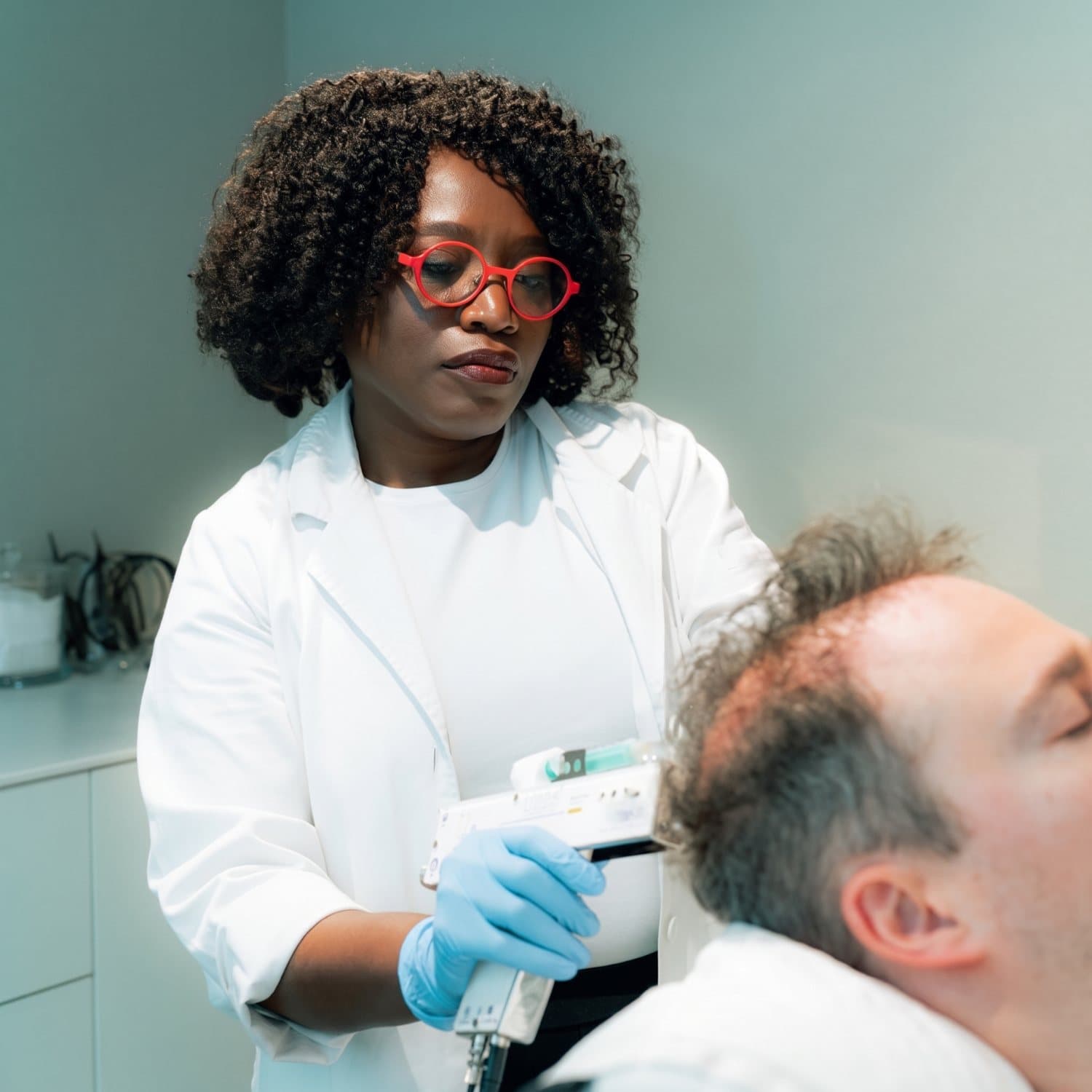
Anagen runs five hair clinics across Switzerland, in Zurich, Geneva, Nyon, Neuchâtel and Lausanne. Leads were never the problem. Managing them was.
Every location was pulling in leads, from walk-ins, referrals and the website. Someone had to call each one back, and consultations were booked by hand, often across several calendars, on top of looking after the patients already coming in. Each clinic had its own appointments and its own calendar, but no one could see the pipeline for all five. A lead that came in on Friday waited until Monday, which is no way to run a business.
We built one system that takes a patient from their first scan to a signed contract, and then keeps running the clinic after that. It has two layers, one the patient sees and one the clinic sees, and they talk to each other constantly.
The patient side: a diagnosis in under a minute
The patient answers a short guided questionnaire and uploads four photos of their scalp. The model takes it from there: in seconds it analyses hairline recession, hair density and the thinning pattern, and generates a report.
Before the report unlocks, the patient verifies their phone number by SMS. That single step does a lot of quiet work. It keeps fake submissions out of the pipeline, and it means the clinic has a confirmed number the moment a real lead appears.
The patient then receives a five-metric report with their Norwood stage, pricing and treatment recommendations. Up to this point everything is automated and no staff are involved, and the patient, who often just wants a clear answer, has one.
The clinic side: a CRM that mostly runs itself
Every scan lands in the CRM the instant it is submitted, tagged with its source and placed on a Kanban board, where it can be followed through each stage until the contract is signed.
- The voice agent calls first. Within minutes, every new lead gets a phone call in English, Swiss-German or French, depending on their region. The agent walks through the scan results, answers the obvious questions and books a consultation. The recording and transcript are attached to the lead, so the consultant walking into that appointment already knows what was discussed and what the patient is worried about.
- Emails follow on a schedule. A condition-specific email journey starts on its own, with messages on day 0, 3, 7 and 11.
- Closing happens in the room. During the consultation, the consultant pulls up a visual treatment catalogue with live pricing, sets the payment terms and takes an e-signature on the spot. The moment it is signed, the deal moves itself to the next stage. No paperwork, and no follow-up email to chase.
- One calendar for everything. Every appointment, room and consultant across all five clinics sits in one real-time view, whether the booking came from the voice agent, the website or the front desk. Double bookings are gone.
- Newsletters take seconds. Marketing describes a topic and gets back a formatted newsletter in French and English, ready to send.
- HR and inventory live in the same place. Staff scheduling and stock management sit inside the same platform, so the COO isn’t switching between tools to run five locations.
It is the way these pieces are wired together that makes the system work. A lead can go from uploading photos to signing a contract without a single person stepping in, and the clinic can still see every step of how it got there.
What changed for Anagen
- 1,100+
- leads in the pipeline
- 77
- new deals created in a single month
- CHF 100K+
- additional signed revenue per month
Why it worked
Two decisions mattered most.
The first was treating the CRM as the foundation instead of an afterthought. It is tempting to put an AI agent on top of whatever already exists, but without a foundation it rarely holds. AI on top of a messy data model is decoration. AI on top of a clean one is an operation.
The second was automating the whole chain, not one link of it. A voice agent that books consultations is useful. A voice agent whose booking lands in a shared calendar, triggers the right email sequence and moves the deal forward is something else.
The value isn’t in any one step. It’s in the fact that no step depends on a human remembering to do it.
Anagen still runs five clinics. It just doesn’t take five clinics’ worth of effort anymore.